Red Envelopes (Hongbao)
红包
The gift of red envelopes that carries blessings, luck, and the power to suppress evil.
Origin Story
The Demon Called Sui
The origin of the red envelope lies in an ancient folk tale about a demon called Sui. According to the legend, Sui was a malevolent spirit that appeared on [New Year](/folklore/lunar-new-year)'s Eve to pat the heads of sleeping children. The children touched by Sui would develop a fever and become simple-minded.
A worried couple, trying to protect their child, kept the lights on and gave the child [coin](/symbols/coin)s to play with. When the child fell asleep, the parents placed the coins on [red pape](/symbols/red)r beside the pillow. When Sui approached, the coins emitted a bright flash that frightened the demon away. From that night on, parents began wrapping coins in red paper for their children on New Year's Eve — the first red envelopes.
The money inside was called 'ya sui qian' — 'money to suppress Sui.' Over time, 'sui' came to be associated with 'sui' meaning 'year,' transforming the meaning to 'money to suppress the passing year' — a gift to ensure the child's safe passage into the [new year. T](/folklore/lunar-new-year)he phonetic pun enriched the tradition with layers of meaning.
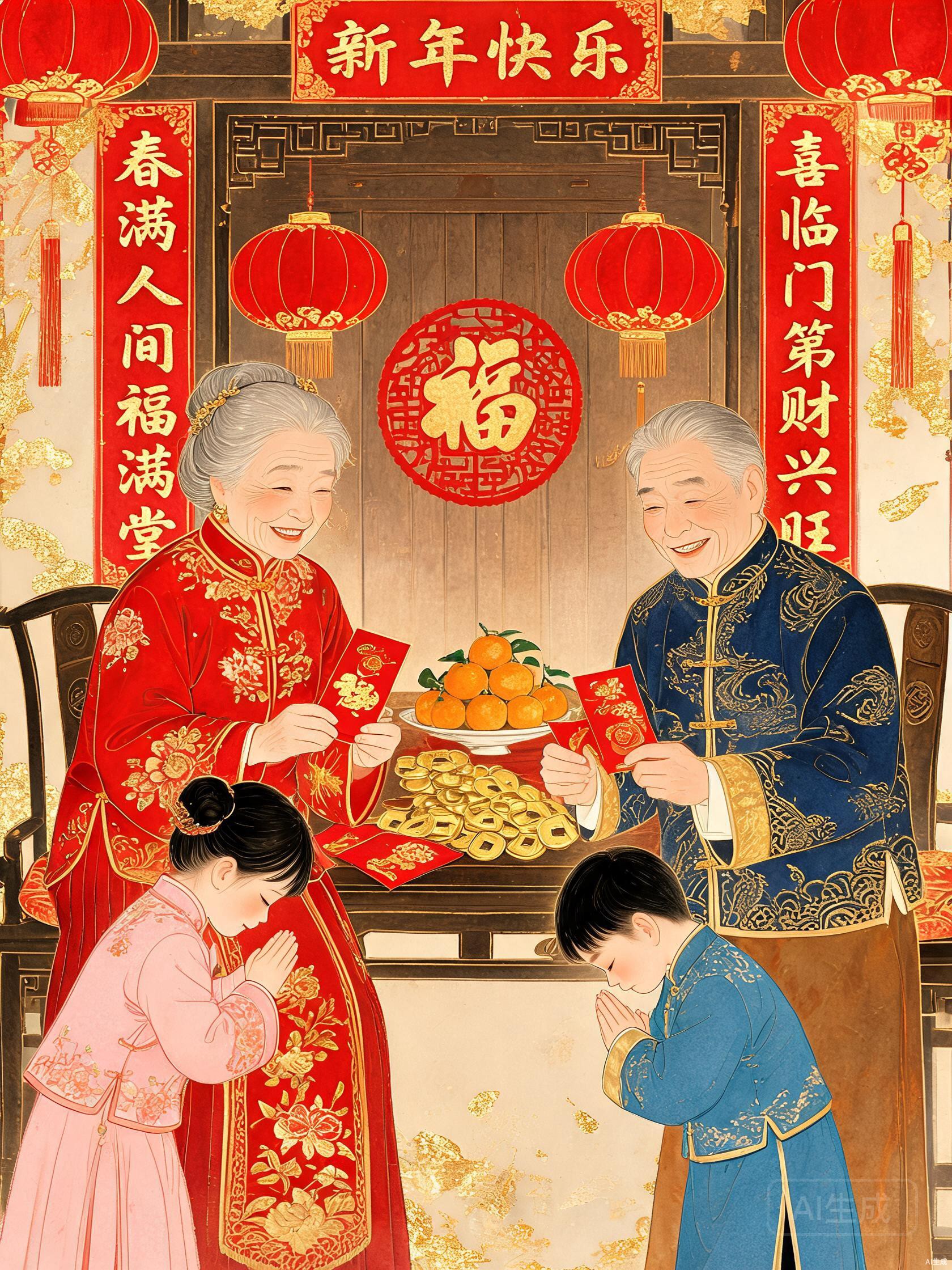
Red envelopes (hongbao) are small [red paper](/symbols/red) packets filled with money, given during the Spring Festival, weddings, birthdays, and other celebratory occasions. The red color represents good fortune and the money inside, called ya sui qian ('money to suppress evil'), is believed to protect the recipient from harm and bring blessings for the year ahead.
Powers & Symbols
Attributes & Artefacts
Click each card to reveal the details behind Red Envelopes (Hongbao)'s divine attributes.
Historical & Cultural Meaning
Beyond the Myth
The Etiquette of Giving
[Red](/symbols/red-envelopes) envelope etiquette is an intricate social code. During the [Spring Festival](/symbols/spring-festival), married adults give red envelopes to children and unmarried adults. Elders give to younger family members. Bosses give to employees. The amount is always an even number and preferably contains the digit 8 (ba, which sounds like 'fa,' meaning prosperity). The number 4 (si, which sounds like 'death') is strictly avoided.
The envelope itself is as important as the money inside. New, crisp bills should be used — never old or wrinkled ones. The envelope should be presented and received with both hands, as a sign of respect. It is considered rude to open the envelope in front of the giver; instead, it should be discreetly tucked away and opened later in private.
The social dynamics of red envelope giving are complex. The amount given must be calibrated to the relationship and the occasion — too little is insulting, too much creates an obligation to reciprocate. During weddings, families keep careful records of who gave how much, ensuring that the same amount (or more) is returned when the giver's own children marry.
From Paper to Digital
In 2014, WeChat introduced digital red envelopes, revolutionizing the tradition. Users could send virtual red envelopes containing digital money to friends and family through the messaging app. The feature went viral: during the 2024 [Spring Festival](/folklore/spring-festival), over 80 billion digital red envelopes were ex[change](/zodiac/change)d on WeChat alone.
The digital red envelope preserved the essential elements of the tradition — the red color, the surprise element, the social bonding — while adding new dimensions. Group chats could feature 'grabbed' red envelopes where the first person to tap the screen gets a random share, creating a game-like experience. Companies used digital red envelopes for marketing, and influencers gave them to followers as engagement tools.
Despite this digital revolution, physical red envelopes remain irreplaceable in many contexts. The tactile experience of holding a thick red envelope from a grandparent, the crinkle of the paper, the anticipation of opening it — these sensory dimensions cannot be replicated on a screen. The red envelope tradition endures because it carries something more than money: it carries the physical presence of care.
Sources & References
Primary classical texts: Shanhaijing (山海经, Classic of Mountains and Seas, c. 4th-2nd century BCE) · Fengshen Yanyi (封神演义, Investiture of the Gods, c. 16th century) · Journey to the West (西游记, Xiyouji, c. 16th century) · Records of the Grand Historian (史记, Shiji, by Sima Qian, c. 91 BCE) · Classic of Mountains and Seas commentary (郭璞注 Shanhaijing, c. 4th century) · Bamboo Annals (竹书纪年, c. 4th century BCE onwards)
Classical translations: Legge, James (trans.). The Sacred Books of the East (1879-1910, 50 volumes covering Chinese classics) · Girardot, Norman J. Myth and Meaning in Early Taoism (University of California Press, 1983) · Werner, E.T.C. A Dictionary of Chinese Mythology (Shanghai: Kelly & Walsh, 1932)
Modern academic references: Birrell, Anne. Chinese Mythology: An Introduction (Baltimore: Johns Hopkins University Press, 1993) · Yang, Lihui, and Deming An. Handbook of Chinese Mythology (New York: Oxford University Press, 2005) · Strassberg, Richard E. A Chinese Bestiary: Strange Creatures from the Guideways Through Mountains and Seas (Berkeley: University of California Press, 2002)
Digital encyclopedias and online resources: Wikipedia — Chinese mythology portal (continuously updated, citations to primary sources) · Encyclopedia Britannica — Mythology and Religion section
Mythology Network
Connections & Relationships
Red Envelopes (Hongbao) is woven into a larger web of gods, creatures, and legends. Explore the connections below.
Red Envelopes (Hongbao)
红包

Explore the Topic
Red Envelopes (Hongbao) in the Mythology Network
Go deeper — read the topic guides that gather every folk tradition like Red Envelopes (Hongbao).