Butterfly Lovers
梁山伯与祝英台
China's Romeo and Juliet — two lovers who defied convention and became butterflies in death.
Origin Story
A Woman in Disguise
In the Eastern Jin Dynasty, a young woman named Zhu Yingtai wanted to study — but in that era, girls were not permitted to attend school. Undeterred, she disguised herself as a young man and traveled to a school in Hangzhou, where she enrolled as a scholar. For three years, she lived among male students, her true identity a carefully guarded secret.
There she met [Liang Shanbo](/myths/liang-shanbo), a kind, earnest, and somewhat naive young scholar. The two became the closest of friends — sworn brothers in scholarship, inseparable in their studies. What Liang did not know was that Zhu Yingtai had fallen deeply in love with him. She dropped hints, spoke of a twin sister she could introduce him to, and tried in every way to tell him the truth without breaking her disguise. But Liang, honest and trusting, never suspected that his best friend was a woman, or that her feelings were more than brotherly.
The Legend of the Butterfly Lovers tells the story of Liang Shanbo and Zhu Yingtai, two young scholars who fell in love while studying together. Forced apart by an arranged marriage, they died of grief and were transformed into butterflies, reunited at last beyond the reach of the world that had separated them.
Powers & Symbols
Attributes & Artefacts
Click each card to reveal the details behind Butterfly Lovers's divine attributes.
Historical & Cultural Meaning
Beyond the Myth
A Revelation Too Late
[Zhu Yingtai](/myths/zhu-yingtai) was called home by her father, who had arranged a marriage for her with a [wealth](/gods/caishen)y young man named Ma Wencai. Before she left, she asked Liang to visit her home and meet her twin sister. Liang agreed, but it was months before he made the journey. When he arrived at the Zhu household, he was greeted not by a sister but by Zhu Yingtai herself, dressed as a woman.
The truth struck Liang like a thunderbolt. He realized in an instant that the best friend he loved as a brother was a woman — and that he loved her as far more. But the revelation came too late. [Zhu Yingtai](/myths/zhu-yingtai) was already promised to Ma Wencai, and the engagement could not be broken. The two parted in anguish, and [Liang Shanbo](/myths/liang-shanbo), crushed by grief and longing, fell mortally ill and died.
The Grave Opens
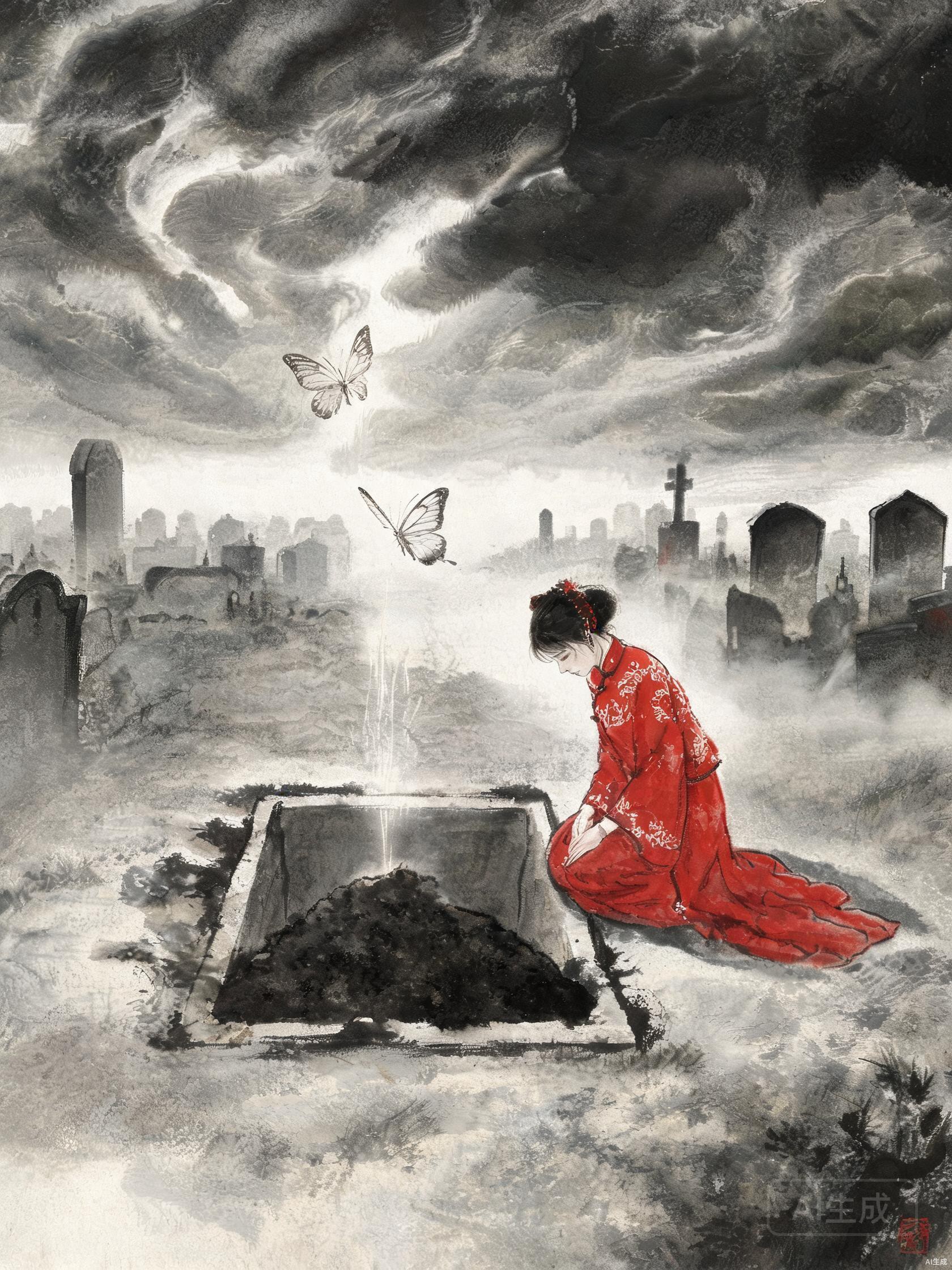
On her wedding day, as Zhu [Yin](/symbols/yin-yang)gtai's bridal procession passed the cemetery where [Liang Shanbo](/myths/liang-shanbo) was buried, she demanded that the carriage stop. She stepped out in her red wedding dress and knelt before Liang's grave. The sky darkened, the wind howled, and the earth split open. The grave burst apart, and [Zhu Yingtai](/myths/zhu-yingtai), in an act of ultimate devotion, threw herself into it.
The earth closed over her. The grave was whole again, and the mourners were left in stunned silence. But from the tomb, two butterflies rose into the air — a pair, dancing together in the wind. They were Liang and Zhu, transformed at last into creatures that no arranged marriage, no social convention, no worldly barrier could ever separate. They flew away together, free.
The Chinese Romeo and Juliet
The Legend of the Butterfly Lovers (Liang-Zhu) is one of China's Four Folk Legends and is often called the Chinese Romeo and Juliet — though it predates Shakespeare's play by over a thousand years. It speaks to a universal experience: love thwarted by the rigid structures of society, and the hope that such love can find freedom in another form.
The story has been retold in every medium of Chinese art — in operas, films, ballets, TV series, and one of the most famous violin concertos of the twentieth century, the [Butterfly Lovers](/myths/butterfly-lovers) Violin Concerto (1959). The image of two butterflies flying together has become a universal symbol of eternal love in Chinese culture, and the name Liang-Zhu is synonymous with romance doomed by circumstance. At Mount Gaosu in Zhejiang, visitors can still visit the tomb where the lovers are said to rest together.
Sources & References
Primary classical texts: Shanhaijing (山海经, Classic of Mountains and Seas, c. 4th-2nd century BCE) · Fengshen Yanyi (封神演义, Investiture of the Gods, c. 16th century) · Journey to the West (西游记, Xiyouji, c. 16th century) · Records of the Grand Historian (史记, Shiji, by Sima Qian, c. 91 BCE) · Classic of Mountains and Seas commentary (郭璞注 Shanhaijing, c. 4th century) · Bamboo Annals (竹书纪年, c. 4th century BCE onwards)
Classical translations: Legge, James (trans.). The Sacred Books of the East (1879-1910, 50 volumes covering Chinese classics) · Girardot, Norman J. Myth and Meaning in Early Taoism (University of California Press, 1983) · Werner, E.T.C. A Dictionary of Chinese Mythology (Shanghai: Kelly & Walsh, 1932)
Modern academic references: Birrell, Anne. Chinese Mythology: An Introduction (Baltimore: Johns Hopkins University Press, 1993) · Yang, Lihui, and Deming An. Handbook of Chinese Mythology (New York: Oxford University Press, 2005) · Strassberg, Richard E. A Chinese Bestiary: Strange Creatures from the Guideways Through Mountains and Seas (Berkeley: University of California Press, 2002)
Digital encyclopedias and online resources: Wikipedia — Chinese mythology portal (continuously updated, citations to primary sources) · Encyclopedia Britannica — Mythology and Religion section
Mythology Network
Connections & Relationships
Butterfly Lovers is woven into a larger web of gods, creatures, and legends. Explore the connections below.
Butterfly Lovers
梁山伯与祝英台



Explore the Topic
Butterfly Lovers in the Mythology Network
Go deeper — read the topic guides that gather every legend like Butterfly Lovers.