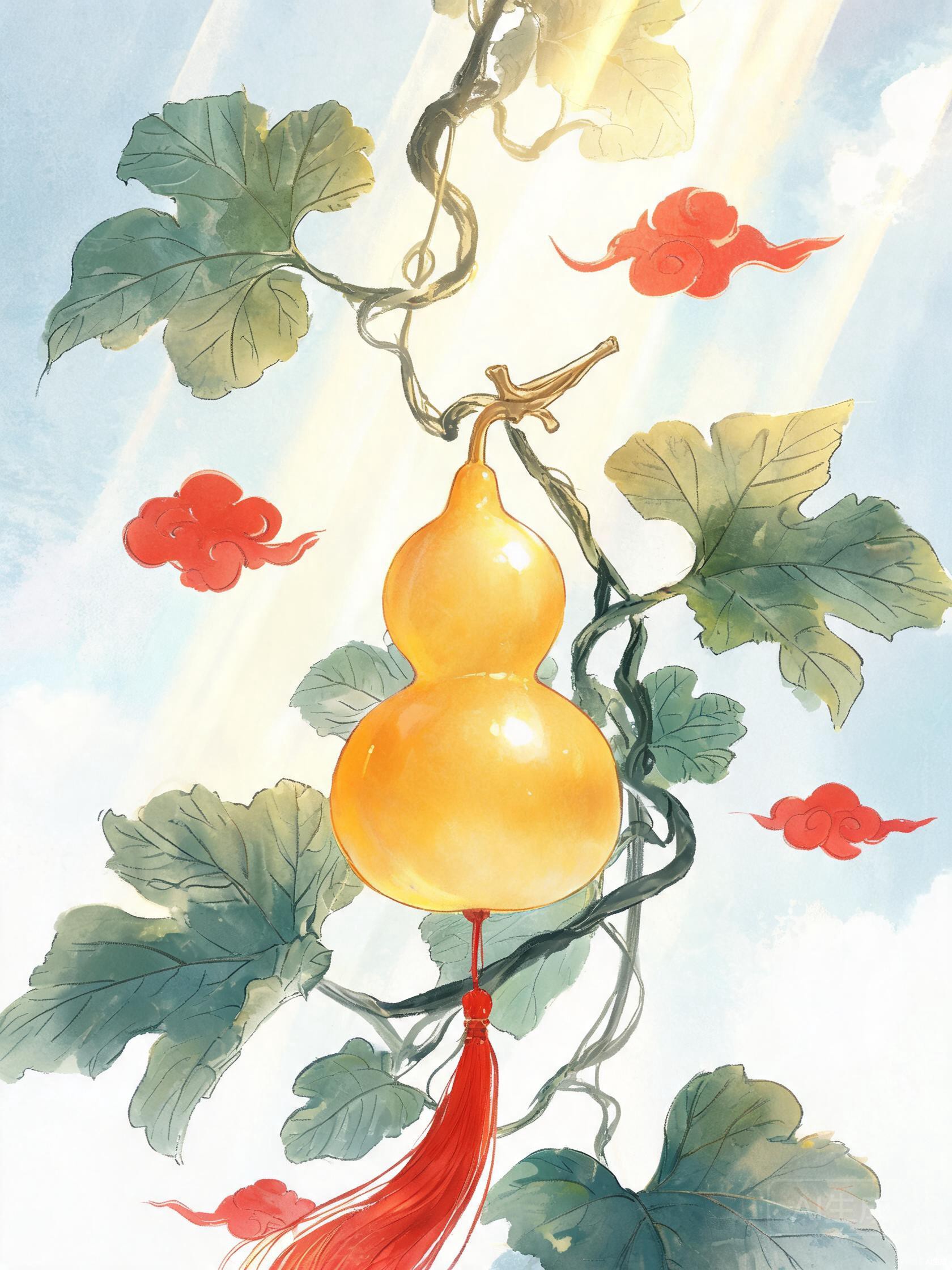
Gourd Symbolism
葫芦
The gourd that carries immortality and gathers fortune — a symbol of health, wealth, and protection.
Origin Story
What Is the Gourd Symbol?
The gourd (葫芦, húlu) is a climbing plant whose fruit forms a distinctive shape — two rounded spheres joined by a narrow waist. In Chinese culture, this humble agricultural product became one of the most potent auspicious symbols, prized for its shape, its name, and its association with the divine. The gourd is among the oldest cultivated plants in China, and its symbolic uses stretch back to the earliest recorded traditions.
The gourd's shape is itself symbolic. The upper sphere represents heaven, and the lower sphere represents earth. The narrow waist between them is the connection between the two realms, a channel through which spiritual power can flow. This makes the gourd a natural vessel for spiritual power — a container that can hold the energy of both the celestial and terrestrial worlds. Taoist priests and folk healers have used gourds as containers for medicines, elixirs, and magical substances for thousands of years, and the image of a gourd hung at the door of a healer became a universal sign of the medical profession in China.
Beyond its shape and practical uses, the gourd is valued for its durability. When dried, the shell becomes hard and watertight, ideal for carrying liquids on long journeys. Immortals and wandering monks were said to carry the gourd as a water vessel, a wine container, and a receptacle for magical potions. This is why the gourd became so closely associated with the mysterious and the divine — it was the practical companion of those who lived between the human and spirit worlds.
The gourd (hulu) is one of the most beloved auspicious symbols in Chinese culture. Its shape is said to represent heaven and earth, its name sounds like words for fortune and prosperity, and it has been carried by immortals and used in folk magic for centuries to absorb illness and attract good luck.
Powers & Symbols
Attributes & Artefacts
Click each card to reveal the details behind Gourd Symbolism's divine attributes.
Historical & Cultural Meaning
Beyond the Myth
The Power of the Pun
Chinese symbolism relies heavily on wordplay, and the gourd is a perfect example. The word húlu (葫芦) sounds similar to fúlú (福禄), which means 'fortune and prosperity' — two of the most desired blessings in Chinese culture. Fu is the character for good fortune seen on red paper everywhere during Chinese New Year, while Lu refers to official salary and wealth. By displaying a gourd, you symbolically invite both blessings into your home at once.
The gourd is also called húlú in some dialects, which sounds like hùlù (护禄), meaning 'to protect [wealth](/gods/caishen).' This makes the gourd a symbol not just of attracting fortune but of safeguarding it. In Feng Shui, gourds are often placed near the entrance of a home or business to catch and hold good energy that might otherwise dissipate. The pun works in reverse too — because the gourd is shaped to 'hold' things, it is believed to hold onto the luck it gathers, rather than letting it flow away.
Another layer of wordplay comes from the gourd's association with the word for 'generations' (lù, 蔓). A vine of gourds, with many fruits hanging in a line, symbolizes 'a thousand generations of descendants' (万代绵长), making it a popular motif for wedding gifts and family blessings. The gourd vine's tendency to climb and spread is seen as a metaphor for a flourishing family line.
The Gourd and the Immortals
In Chinese mythology and Taoist tradition, the gourd is the signature vessel of the immortals. [Li Tieguai](/gods/li-tieguai) (Iron Crutch Li), one of the Eight Immortals, carries a large gourd containing a magical potion that can cure any illness. He is often depicted drinking from his gourd or emerging from it, and in some stories he can shrink himself to fit inside and travel vast distances in an instant. The gourd is as much a part of his identity as his iron crutch.
The gourd also appears in the hands of Shouxing, the god of longevity, who uses it to hold the elixir of immortality. In the legend of the Lady [Meng Jiang](/myths/meng-jiangnv-weeping-great-wall), who wept down the Great Wall, a gourd is the vessel that carries the magic water. In the folk tale of the Calabash Brothers (葫芦兄弟), seven brothers are born from a single gourd vine and use their magical powers to fight demons. The gourd is consistently portrayed as a container of supernatural power — a vessel that holds what is precious, healing, or otherworldly.
This association with healing and [immortal](/gods/buddha-shakyamuni)ity made the gourd a common tool in folk medicine. Traditional doctors would carry medicine in small gourds, and the gourd became a visual shorthand for the healing profession. Even today, some traditional Chinese medicine shops display a gourd outside their doors as a sign of their trade, just as a red cross identifies a pharmacy in the West.
Gourd Symbolism in Daily Life
In modern Feng Shui practice, the gourd is used as a 'cure' for several specific problems. A brass or natural gourd placed near the bed of a sick person is believed to absorb the illness energy and speed recovery. A gourd placed in the bedroom is also used to improve marital harmony, as the two spheres symbolize the union of two people. A gourd near the entrance is said to catch evil spirits and misfortune before they can enter the home, acting as a spiritual filter.
The gourd also appears in Chinese art and decorative traditions. Paintings of gourds are given as gifts for new homes and businesses, often paired with the character for 'fortune' to doubly invoke prosperity. Jade carvings shaped like gourds are worn as amulets for health and protection. During the [Dragon Boat](/folklore/dragon-boat-festival) Festival, gourd-shaped charms are hung in homes to ward off disease and the 'five poisons' of summer — snakes, scorpions, centipedes, toads, and lizards. The gourd's enduring popularity testifies to its versatility as a symbol that bridges the practical, the spiritual, and the auspicious.
In homes across China, a small dried gourd or a brass replica remains one of the most common Feng Shui objects. It is simple, beautiful, and meaningful — a reminder that the most profound symbols are often grown from the most ordinary things. From a climbing vine to a vessel of the gods, the gourd carries the full weight of Chinese folk wisdom in its two small spheres.
Sources & References
Primary classical texts: Shanhaijing (山海经, Classic of Mountains and Seas, c. 4th-2nd century BCE) · Fengshen Yanyi (封神演义, Investiture of the Gods, c. 16th century) · Journey to the West (西游记, Xiyouji, c. 16th century) · Records of the Grand Historian (史记, Shiji, by Sima Qian, c. 91 BCE) · Classic of Mountains and Seas commentary (郭璞注 Shanhaijing, c. 4th century) · Bamboo Annals (竹书纪年, c. 4th century BCE onwards)
Classical translations: Legge, James (trans.). The Sacred Books of the East (1879-1910, 50 volumes covering Chinese classics) · Girardot, Norman J. Myth and Meaning in Early Taoism (University of California Press, 1983) · Werner, E.T.C. A Dictionary of Chinese Mythology (Shanghai: Kelly & Walsh, 1932)
Modern academic references: Birrell, Anne. Chinese Mythology: An Introduction (Baltimore: Johns Hopkins University Press, 1993) · Yang, Lihui, and Deming An. Handbook of Chinese Mythology (New York: Oxford University Press, 2005) · Strassberg, Richard E. A Chinese Bestiary: Strange Creatures from the Guideways Through Mountains and Seas (Berkeley: University of California Press, 2002)
Digital encyclopedias and online resources: Wikipedia — Chinese mythology portal (continuously updated, citations to primary sources) · Encyclopedia Britannica — Mythology and Religion section
Mythology Network
Connections & Relationships
Gourd Symbolism is woven into a larger web of gods, creatures, and legends. Explore the connections below.
Gourd Symbolism
葫芦


Explore the Topic
Gourd Symbolism in the Mythology Network
Go deeper — read the topic guides that gather every symbol like Gourd Symbolism.