Dragon Dance
舞龙
The magnificent dance of the celestial dragon that brings rain and prosperity.
Origin Story
The Living Dragon
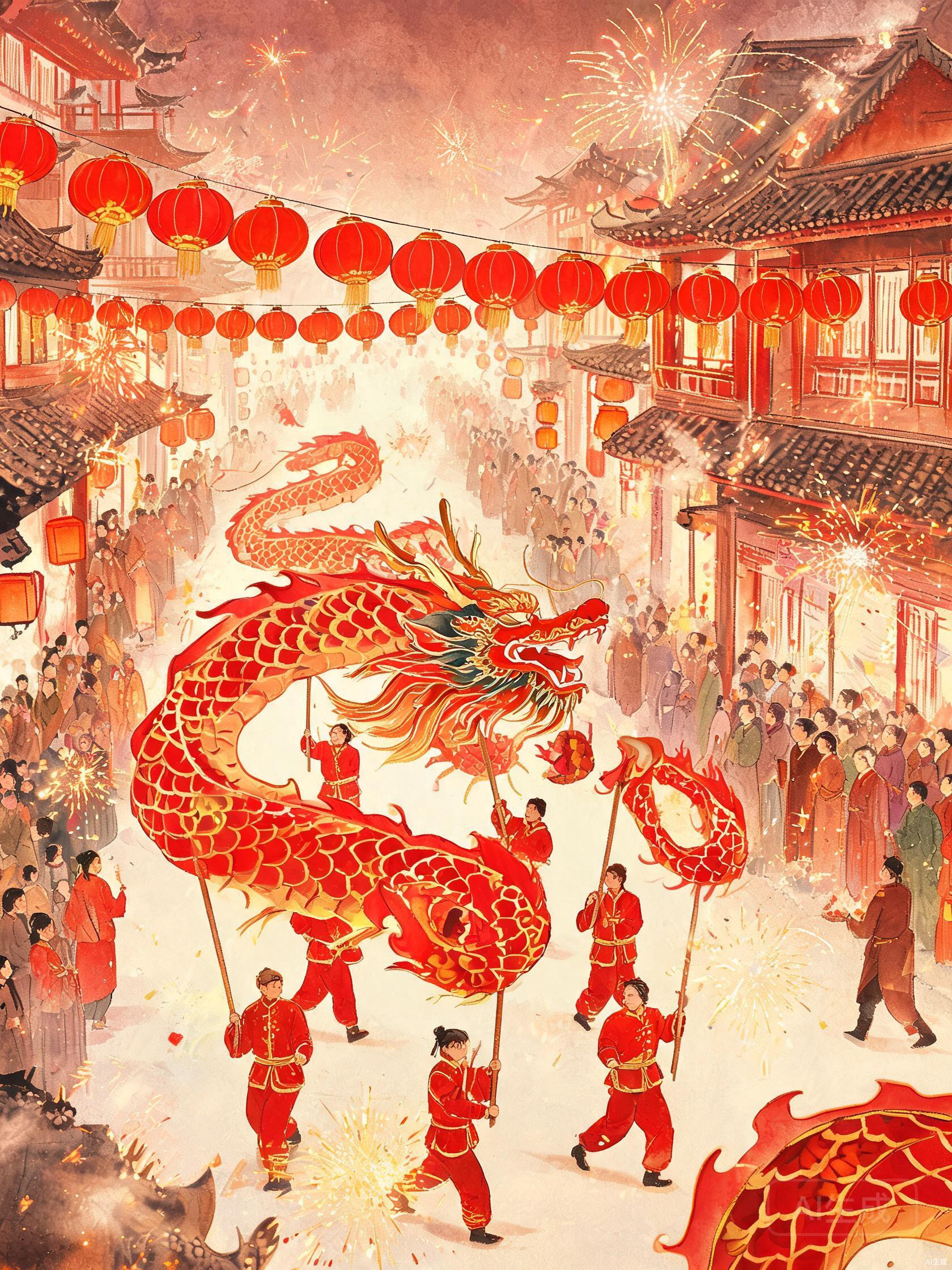
The dragon dance brings the [Chinese dragon](/creatures/chinese-dragon) — the most powerful symbol in Chinese culture — to life. The costume consists of a large, elaborate head (often weighing 12 kilograms or more) followed by a long fabric body supported by bamboo poles, one for each performer. The final segment is the tail, which must move in harmony with the head.
The lead performer, holding the 'Pearl of Wisdom' on a pole, guides the dragon's movements. The dragon pursues the pearl in sweeping, circular patterns — sometimes chasing it, sometimes circling it, sometimes seeming to swallow it. This pursuit represents the eternal quest for wisdom, knowledge, and enlightenment.
The body performers must follow the head in a seamless wave, each person's pole rising and falling in sequence to create the dragon's undulating motion. A team of fifty performers can make a dragon appear to fly, coil, dive, and spiral with breathtaking fluidity. The coordination required is immense — a single mistimed movement breaks the illusion and disrupts the entire dance.
The [Dragon](/zodiac/zodiac-dragon) Dance is a spectacular Chinese performance art in which a team of performers manipulates a long, flexible dragon costume on poles. Unlike the [lion dance](/folklore/lion-dance) (two performers), the dragon dance requires a team of nine to fifty performers, who move in undulating, serpentine patterns that bring the dragon to life. It is performed during major festivals to bring rain, prosperity, and good fortune.
Powers & Symbols
Attributes & Artefacts
Click each card to reveal the details behind Dragon Dance's divine attributes.
Historical & Cultural Meaning
Beyond the Myth
Rain and Prosperity
The dragon dance originated as a rain-making ritual. In ancient China, where agriculture depended entirely on rainfall, the dragon — as the divine controller of water and weather — was petitioned through dance to bring life-giving rain. The undulating movements of the dragon costume mimicked the flowing of water and the coiling of clouds.
Over centuries, the rain-making function evolved into a more general appeal for prosperity and good fortune. The dragon that brings rain also brings abundance; the creature that controls water also controls [wealth](/gods/caishen). By the Tang Dynasty, the dragon dance had become a standard feature of festival celebrations, performed to ensure a bountiful year ahead.
Today, the dragon dance is performed at business openings, weddings, and any occasion that calls for blessings of prosperity. Businesses often commission dragon dances for their grand openings, believing that the dragon's passage through the premises cleanses the space of bad luck and invites good fortune. The longer the dragon, the greater the luck it brings.
A Global Tradition
The dragon dance has been embraced worldwide as a symbol of Chinese culture. In cities with significant Chinese populations — from San Francisco to London to Melbourne — the dragon dance is a centerpiece of [Lunar New Year](/folklore/spring-festival) celebrations, drawing crowds of all backgrounds. The sight of a hundred-foot dragon weaving through city streets, accompanied by thundering drums, is one of the most thrilling spectacles in cultural performance.
Competitive dragon dancing has also emerged as a sport. International dragon dance competitions judge teams on choreography, difficulty, synchronization, and artistic expression. Some teams perform on elevated poles, creating the illusion of a dragon flying through clouds — a breathtaking variation that requires extraordinary strength, balance, and trust between performers.
The dragon dance endures because it embodies something fundamental about Chinese culture: the belief that collective effort, discipline, and harmony can bring something magnificent into being. A single performer cannot make a dragon dance; it takes a team moving as one, each person trusting the others, each movement building on the last. In this way, the dragon dance is not just a performance — it is a living metaphor for community itself.
Sources & References
Primary classical texts: Shanhaijing (山海经, Classic of Mountains and Seas, c. 4th-2nd century BCE) · Fengshen Yanyi (封神演义, Investiture of the Gods, c. 16th century) · Journey to the West (西游记, Xiyouji, c. 16th century) · Records of the Grand Historian (史记, Shiji, by Sima Qian, c. 91 BCE) · Classic of Mountains and Seas commentary (郭璞注 Shanhaijing, c. 4th century) · Bamboo Annals (竹书纪年, c. 4th century BCE onwards)
Classical translations: Legge, James (trans.). The Sacred Books of the East (1879-1910, 50 volumes covering Chinese classics) · Girardot, Norman J. Myth and Meaning in Early Taoism (University of California Press, 1983) · Werner, E.T.C. A Dictionary of Chinese Mythology (Shanghai: Kelly & Walsh, 1932)
Modern academic references: Birrell, Anne. Chinese Mythology: An Introduction (Baltimore: Johns Hopkins University Press, 1993) · Yang, Lihui, and Deming An. Handbook of Chinese Mythology (New York: Oxford University Press, 2005) · Strassberg, Richard E. A Chinese Bestiary: Strange Creatures from the Guideways Through Mountains and Seas (Berkeley: University of California Press, 2002)
Digital encyclopedias and online resources: Wikipedia — Chinese mythology portal (continuously updated, citations to primary sources) · Encyclopedia Britannica — Mythology and Religion section
Mythology Network
Connections & Relationships
Dragon Dance is woven into a larger web of gods, creatures, and legends. Explore the connections below.
Dragon Dance
舞龙

Explore the Topic
Dragon Dance in the Mythology Network
Go deeper — read the topic guides that gather every folk tradition like Dragon Dance.