Lion Dance
舞狮
The thunderous dance that drives away evil and brings prosperity.
Origin Story
Two Traditions: Northern and Southern
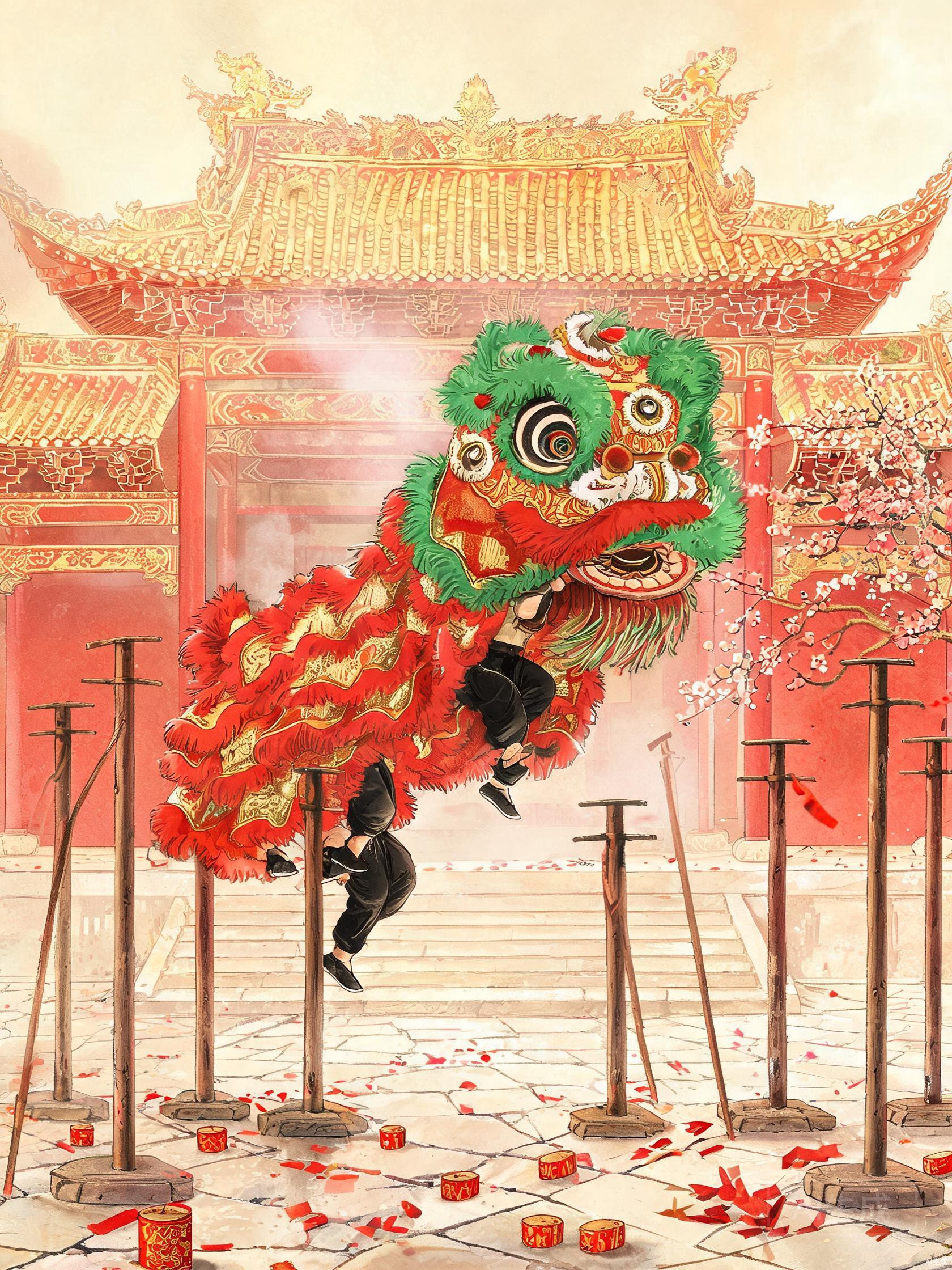
There are two major styles of [lion d](/gods/buddha-shakyamuni)ance in China. The Northern Lion (Bei Shi) features a shaggy, golden-coated lion with a realistic, dog-like face. Northern performances emphasize acrobatics — lions balance on balls, jump through hoops, and perform on elevated platforms. The dance is playful and athletic, often featuring a lion tamer character who interacts with the lions.
The Southern [Lion (Na](/folklore/lunar-new-year)n Shi), more commonly seen worldwide, features a highly stylized lion head with a large, colorful face, prominent eyes, and a mirror on the forehead. The Southern tradition is deeply connected to martial arts — historically, lion dance troupes were affiliated with kung fu schools, and the footwork, stances, and movements of the dance are drawn directly from martial arts training.
The Southern [lion](/gods/bodhidharma) head is operated by a performer who controls the eyes, mouth, and ears, creating expressive movements that convey the lion's emotions — curiosity, fear, aggression, joy. The tail performer must stay bent over throughout the performance, matching the head performer's movements while remaining largely invisible. The synchronization between the two is the hallmark of a skilled troupe.
The Lion Dance — performed to bring luck and ward off evil
The Lion Dance is one of the most beloved traditions in Chinese culture, performed during the [Spring Festival](/folklore/spring-festival), at business openings, weddings, and other celebrations. Two performers operate a large, colorful [lion](/creatures/baihu) costume — one controlling the head, the other the body — in a dynamic display of acrobatics, percussion, and martial arts that drives away evil spirits and ushers in good fortune.
Powers & Symbols
Attributes & Artefacts
Click each card to reveal the details behind Lion Dance's divine attributes.
Historical & Cultural Meaning
Beyond the Myth
Cai Qing: Plucking the Greens
The most important ritual in the Southern [lion dance i](/gods/wenshen)s 'cai qing' — plucking the greens. A head of lettuce (sheng cai, which sounds like 'generating wealth') is hung above the entrance to a home or business, often accompanied by a red envelope. The lion approaches cautiously, examines the offering, then 'eats' the lettuce by tearing it apart with its mouth.
After 'chewing' the lettuce, the [lion 'spits' it ](/gods/wenshen)out — spraying the shredded leaves over the audience and the entrance. This act symbolizes the distribution of good fortune: the lettuce ([wealth](/gods/caishen)) is consumed by the lion and scattered to bring prosperity to the business or household. The red envelope is the lion's reward for this service.
The cai qing ritual can be elaborate. Some businesses create obstacle courses — [lions must ](/folklore/lunar-new-year)climb on benches, cross elevated poles, or navigate through a maze of challenges before reaching the greens. The famous 'pole dancing' version of the lion dance, where performers leap between 10-foot-tall poles, evolved from these challenges. The higher the greens are hung, the greater the fortune they bring.
The Lion's Power
In Chinese folk belief, the lion is a powerful protective creature. Though lions are not native to China (the Chinese lion is a mythical amalgam influenced by descriptions and art from Central Asia), the animal was adopted as a guardian figure as early as the Han Dynasty. Stone lions still guard the entrances of palaces, temples, and important buildings throughout China.
The lion dance channels this protective power. The thundering drumbeat, the clashing cymbals, and the lion's fierce movements are believed to frighten away evil spirits — just as firecrackers drive away the [Nian](/creatures/nian). The dance is both a performance and a ritual of purification, transforming a space from vulnerable to protected.
The tradition has spread worldwide with the Chinese diaspora. Lion dances are now performed in Chinatowns from San Francisco to London to Sydney, and international lion dance competitions draw teams from dozens of countries. What began as a village custom in southern China has become one of the most recognizable symbols of Chinese culture globally — a thunderous, joyful declaration of cultural pride and communal celebration.
Sources & References
Primary classical texts: Shanhaijing (山海经, Classic of Mountains and Seas, c. 4th-2nd century BCE) · Fengshen Yanyi (封神演义, Investiture of the Gods, c. 16th century) · Journey to the West (西游记, Xiyouji, c. 16th century) · Records of the Grand Historian (史记, Shiji, by Sima Qian, c. 91 BCE) · Classic of Mountains and Seas commentary (郭璞注 Shanhaijing, c. 4th century) · Bamboo Annals (竹书纪年, c. 4th century BCE onwards)
Classical translations: Legge, James (trans.). The Sacred Books of the East (1879-1910, 50 volumes covering Chinese classics) · Girardot, Norman J. Myth and Meaning in Early Taoism (University of California Press, 1983) · Werner, E.T.C. A Dictionary of Chinese Mythology (Shanghai: Kelly & Walsh, 1932)
Modern academic references: Birrell, Anne. Chinese Mythology: An Introduction (Baltimore: Johns Hopkins University Press, 1993) · Yang, Lihui, and Deming An. Handbook of Chinese Mythology (New York: Oxford University Press, 2005) · Strassberg, Richard E. A Chinese Bestiary: Strange Creatures from the Guideways Through Mountains and Seas (Berkeley: University of California Press, 2002)
Digital encyclopedias and online resources: Wikipedia — Chinese mythology portal (continuously updated, citations to primary sources) · Encyclopedia Britannica — Mythology and Religion section
Mythology Network
Connections & Relationships
Lion Dance is woven into a larger web of gods, creatures, and legends. Explore the connections below.
Lion Dance
舞狮


Explore the Topic
Lion Dance in the Mythology Network
Go deeper — read the topic guides that gather every folk tradition like Lion Dance.