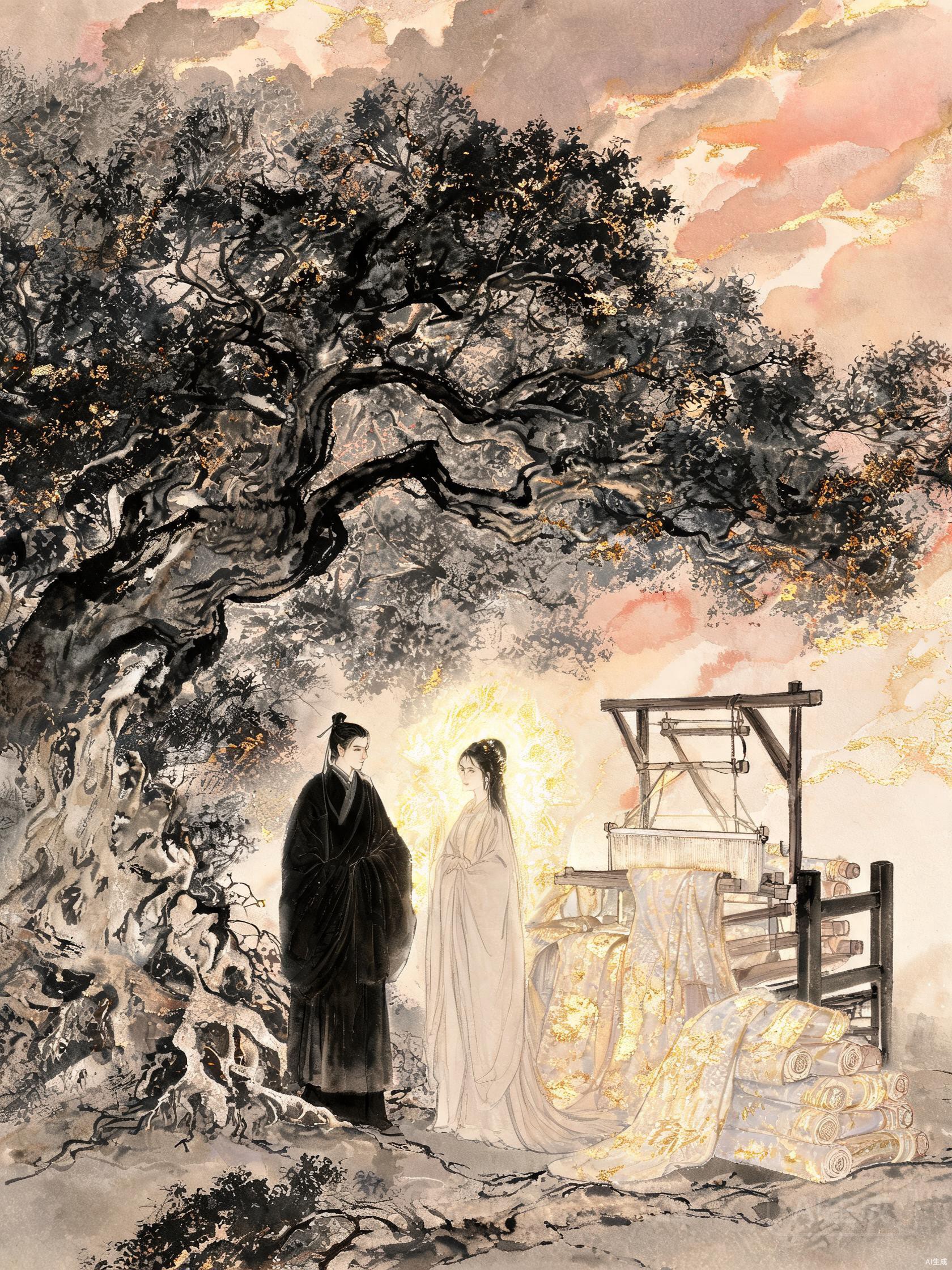
Dong Yong and the Seventh Fairy
董永与七仙女
A filial son who sold himself to bury his father — and won the love of a goddess.
Origin Story
A Son Who Sold Himself
Dong Yong was a poor man of the Han Dynasty who lived with his father. They had nothing — no money, no land, no prospects — but Dong Yong loved his father with a devotion so deep it would become legendary. When his father died, Dong Yong had no way to pay for a funeral. [Rat](/zodiac/zodiac-rat)her than let his father go unburied, he sold himself into servitude to a wealthy man, offering his labor for years in exchange for the money to lay his father to rest.
This act of filial piety — selling oneself to honor a parent — was the highest virtue in the Chinese moral universe. The story says that the heavens themselves took notice. The Jade Emperor, ruler of the celestial realm, was moved by Dong Yong's sacrifice. He decided that such devotion deserved a reward, and he sent his seventh daughter to earth to help this most filial of men.
The legend of Dong Yong and the Seventh Fairy tells of a poor man so devoted to his father that he sold himself into servitude to pay for a funeral. His filial piety moved the heavens, and the Seventh Fairy, daughter of the Jade Emperor, descended to earth to marry him and weave silk to buy his freedom — before duty forced her to return to the sky.
Powers & Symbols
Attributes & Artefacts
Click each card to reveal the details behind Dong Yong and the Seventh Fairy's divine attributes.
Historical & Cultural Meaning
Beyond the Myth
The Seventh Fairy Descends
The Seventh Fairy (七仙女), the youngest and most beautiful of the Jade Emperor's daughters, descended to earth under a great old tree — the meeting place that gives the legend its iconic image. There she met Dong Yong, who was traveling to begin his servitude. The two encountered each other by the tree, and in the simplicity of that meeting, love was born.
She told him she would be his wife, and Dong Yong, bewildered but grateful, accepted. The two married beneath the tree and went together to the home of the [wealth](/gods/caishen)y man who had bought Dong Yong's labor. The master demanded an impossible price for Dong Yong's freedom: he required fine silk fabric, woven to specification, in quantities no mortal could produce. The Seventh Fairy accepted the challenge with quiet confidence.
Weaving the Silk of Heaven
That night, the Seventh Fairy called upon her celestial sisters — the other daughters of the Jade Emperor — to descend from heaven and help her. Together, the fairy sisters wove silk on a heavenly loom, producing fabric of a beauty and fineness that no human hand could match. In a single night, they completed the impossible task, weaving enough silk to buy Dong Yong's freedom.
When the master saw the silk, he released Dong Yong from his debt. The couple was free, and for a brief, golden time, they lived in happiness. But the Seventh Fairy was a daughter of heaven, and her place was not on earth. The [Jade Emperor](/gods/jade-emperor) sent word that she must return. She had broken the boundary between the divine and the mortal, and the order of the cosmos demanded that she go back.
Parting Beneath the Tree
The Seventh Fairy had no choice. She told Dong Yong the truth — that she was a goddess, that she had been sent to reward his filial virtue, and that she must now return to heaven. She was pregnant, and she promised that their child would be born on earth. The two parted beneath the same tree where they had met — an image of reunion and separation that defines the legend.
In some versions, the Seventh Fairy leaves behind a token the child would later use to recognize his mother. The story of [Dong Yong](/myths/dong-yong-seventh-fairy) and the Seventh Fairy is one of China's most beloved romances, a tale where virtue is rewarded with love, but where love cannot overcome the boundary between heaven and earth. It is often paired with the [Cowherd](/myths/cowherd-and-weaver-girl) and the Weaver Girl as a mirror story — a mortal man and a goddess, united by circumstance and separated by the order of the cosmos. The legend has been adapted into the famous 1955 Huangmei opera film Tianxian Pei (The Heavenly Match), which remains one of the most popular Chinese films ever made.
Sources & References
Primary classical texts: Shanhaijing (山海经, Classic of Mountains and Seas, c. 4th-2nd century BCE) · Fengshen Yanyi (封神演义, Investiture of the Gods, c. 16th century) · Journey to the West (西游记, Xiyouji, c. 16th century) · Records of the Grand Historian (史记, Shiji, by Sima Qian, c. 91 BCE) · Classic of Mountains and Seas commentary (郭璞注 Shanhaijing, c. 4th century) · Bamboo Annals (竹书纪年, c. 4th century BCE onwards)
Classical translations: Legge, James (trans.). The Sacred Books of the East (1879-1910, 50 volumes covering Chinese classics) · Girardot, Norman J. Myth and Meaning in Early Taoism (University of California Press, 1983) · Werner, E.T.C. A Dictionary of Chinese Mythology (Shanghai: Kelly & Walsh, 1932)
Modern academic references: Birrell, Anne. Chinese Mythology: An Introduction (Baltimore: Johns Hopkins University Press, 1993) · Yang, Lihui, and Deming An. Handbook of Chinese Mythology (New York: Oxford University Press, 2005) · Strassberg, Richard E. A Chinese Bestiary: Strange Creatures from the Guideways Through Mountains and Seas (Berkeley: University of California Press, 2002)
Digital encyclopedias and online resources: Wikipedia — Chinese mythology portal (continuously updated, citations to primary sources) · Encyclopedia Britannica — Mythology and Religion section
Mythology Network
Connections & Relationships
Dong Yong and the Seventh Fairy is woven into a larger web of gods, creatures, and legends. Explore the connections below.
Dong Yong and the Seventh Fairy
董永与七仙女


Explore the Topic
Dong Yong and the Seventh Fairy in the Mythology Network
Go deeper — read the topic guides that gather every legend like Dong Yong and the Seventh Fairy.