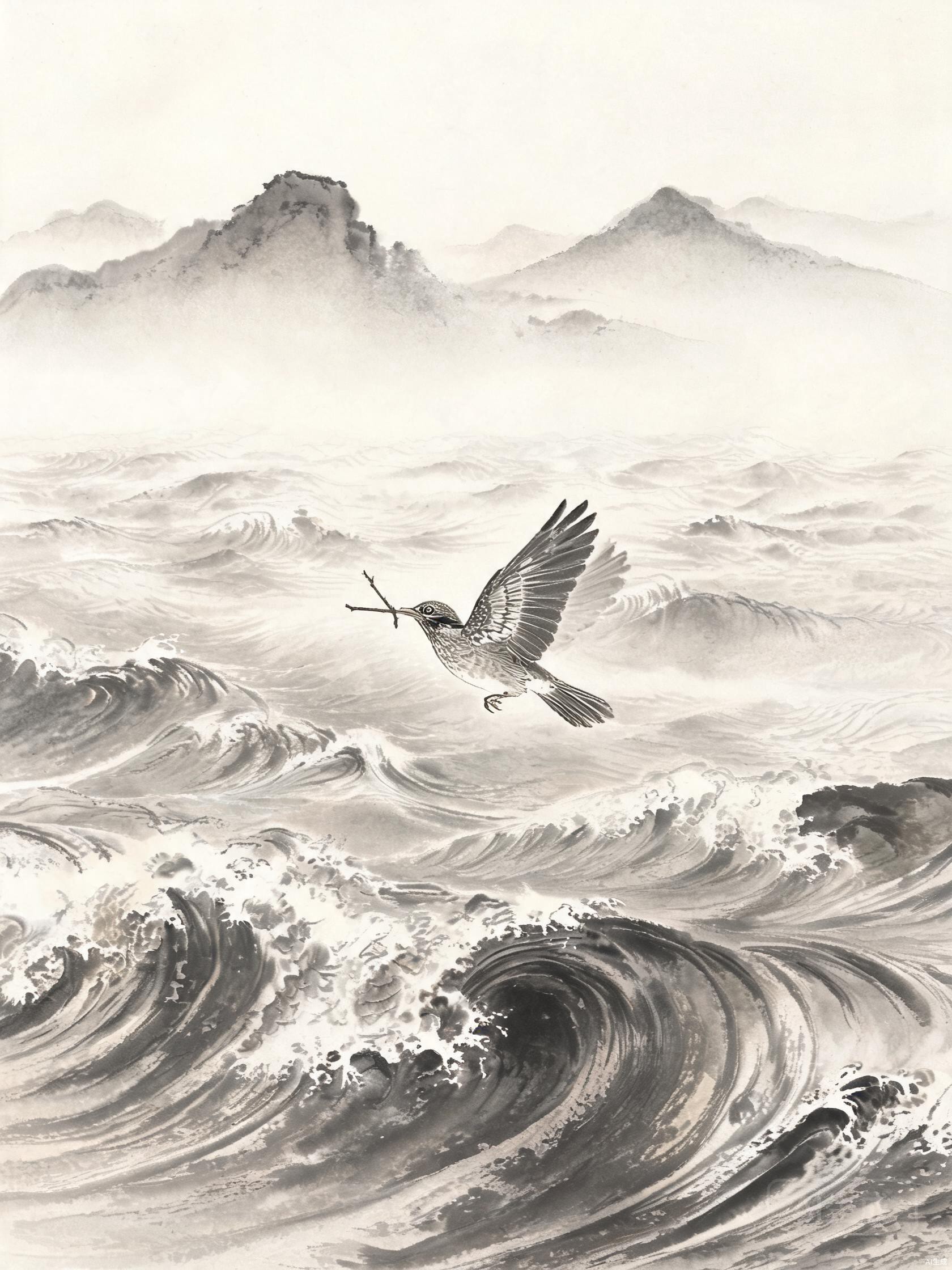
Jingwei Fills the Sea
精卫填海
A bird born from a drowned princess, determined to fill the vast ocean one twig at a time.
Origin Story
The Daughter of the Flame Emperor
[Nüwa](/myths/nuwa-creates-humanity) (女娃), not to be confused with the creator goddess Nuwa (女娲), was the beloved daughter of Yan Di, the Flame Emperor and a legendary sovereign of ancient China. She was a spirited and curious young girl who loved to explore the wonders of the world around her.
One day, she traveled to the shores of the Eastern Sea. The water was calm and inviting, and she waded in to swim. But the sea, vast and unpredictable, suddenly turned violent. Waves rose like mountains and swallowed the girl before anyone could help. She drowned, far from home, in the cold depths of the ocean.
The myth of Jingwei Fills the Sea tells how Nüwa, the daughter of the Yan Di, drowned in the Eastern Sea and was reborn as a small bird named Jingwei, which forever carries twigs and stones to fill the sea that took her life.
Powers & Symbols
Attributes & Artefacts
Click each card to reveal the details behind Jingwei Fills the Sea's divine attributes.
Historical & Cultural Meaning
Beyond the Myth
Rebirth as the Jingwei Bird
Death, however, was not the end. From the waters where [Nüwa](/gods/nuwa) perished, a small bird emerged. It had a patterned head, a white beak, and red claws, and it called out a cry that sounded like its name: jingwei, jingwei. The bird was the spirit of the drowned princess, reborn not as a human but as a tireless creature of the air.
[Jingwei](/myths/jingwei) did not forget what the sea had done. From that day forward, she flew back and forth between the mountains and the Eastern Sea, carrying a single twig or pebble in her beak each time. She dropped it into the water and returned for another, then another — an endless, impossible labor to fill the ocean that had taken her life.
The Defiance of the Small
The Eastern Sea mocked the little bird, asking how she could ever hope to fill its vast waters. [Jingwei](/myths/jingwei) replied that even if it took a million years, she would not stop. She would carry twigs and stones until the sea was filled, or until the world itself ended. The sea laughed, but Jingwei only flew faster.
This is the heart of the myth: the defiance of the small against the vast, the refusal to accept defeat even when the task is impossible. [Jingwei](/myths/jingwei) is not a powerful god or a great hero — she is a small bird with an impossible goal, and that is precisely what makes her story resonate across thousands of years.
Jingwei in Chinese Culture
The phrase [Jingwei](/creatures/jingwei-bird) Tianhai (精卫填海) has become a Chinese idiom meaning relentless perseverance against overwhelming odds. It is used to praise those who refuse to give up, even when success seems impossible — a tribute to the small bird who took on the sea.
The myth is recorded in the Shan Hai Jing (Classic of Mountains and Seas), one of the oldest and most important collections of Chinese mythology. [Jingwei](/myths/jingwei-fills-sea)'s story has inspired poems, paintings, and modern works, and the bird herself has become one of the most enduring symbols of determination in Chinese civilization.
Sources & References
Primary classical texts: Shanhaijing (山海经, Classic of Mountains and Seas, c. 4th-2nd century BCE) · Fengshen Yanyi (封神演义, Investiture of the Gods, c. 16th century) · Journey to the West (西游记, Xiyouji, c. 16th century) · Records of the Grand Historian (史记, Shiji, by Sima Qian, c. 91 BCE) · Classic of Mountains and Seas commentary (郭璞注 Shanhaijing, c. 4th century) · Bamboo Annals (竹书纪年, c. 4th century BCE onwards)
Classical translations: Legge, James (trans.). The Sacred Books of the East (1879-1910, 50 volumes covering Chinese classics) · Girardot, Norman J. Myth and Meaning in Early Taoism (University of California Press, 1983) · Werner, E.T.C. A Dictionary of Chinese Mythology (Shanghai: Kelly & Walsh, 1932)
Modern academic references: Birrell, Anne. Chinese Mythology: An Introduction (Baltimore: Johns Hopkins University Press, 1993) · Yang, Lihui, and Deming An. Handbook of Chinese Mythology (New York: Oxford University Press, 2005) · Strassberg, Richard E. A Chinese Bestiary: Strange Creatures from the Guideways Through Mountains and Seas (Berkeley: University of California Press, 2002)
Digital encyclopedias and online resources: Wikipedia — Chinese mythology portal (continuously updated, citations to primary sources) · Encyclopedia Britannica — Mythology and Religion section
Mythology Network
Connections & Relationships
Jingwei Fills the Sea is woven into a larger web of gods, creatures, and legends. Explore the connections below.
Jingwei Fills the Sea
精卫填海


Explore the Topic
Jingwei Fills the Sea in the Mythology Network
Go deeper — read the topic guides that gather every legend like Jingwei Fills the Sea.